

Chemistry and Biochemistry
Explore the dynamic center of the sciences.
Why Chemistry? A Transformative, Ubiquitous Field of Modern Science
Careers in Medicine
The best physicians combine scientific expertise with a well-rounded interpersonal skill set. At Oberlin, work with our advisors to help pursue your career goals in health and medicine.
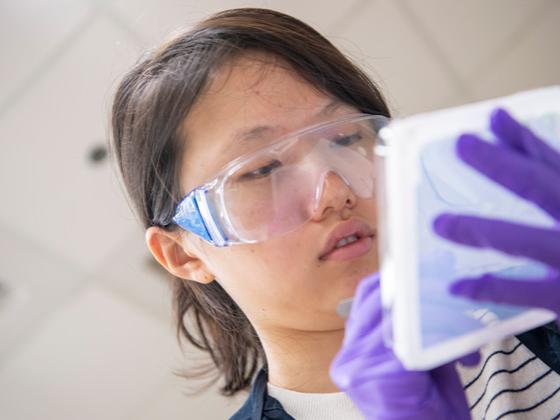
Faculty-Student Collaboration
Mentorship and research are cornerstones of the chemistry and biochemistry programs. At Oberlin, students work with faculty to achieve new scientific discoveries.
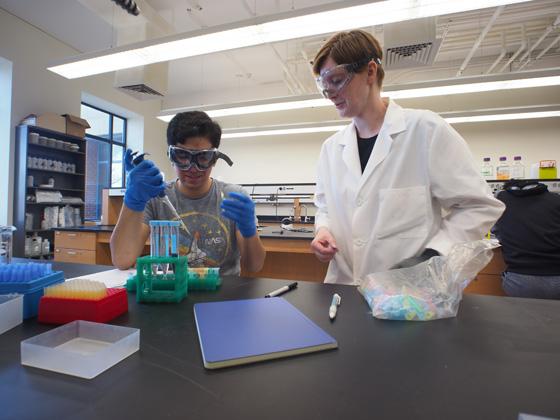
Undergraduate Research

What drives me the most in the research process is the possibility of discovering new things.
Featured Courses
Drugs!
From aspirin to zantac, and oxycodone to gene editing, the development of therapeutic drugs is an interdisciplinary scientific effort that can have profound impacts on our health and society. This course will introduce chemical and biological concepts used in the drug discovery process, as well as ethical, economic, and political considerations.
- Taught by
- Jason Belitsky
Structure and Reactivity
This entry-level course introduces students to the foundational study of reactions, chemical periodicity, bonding, molecular structure, and other questions central to the field of chemistry. Students have the option to join sections that are taught in workshop mode, emphasizing collaborative problem solving and peer discussion.
- Taught by
- Matthew (Matt) Elrod
Synthesis Laboratory
This course introduces students to laboratory work involving the synthesis of organic and inorganic compounds by a variety of techniques (e.g. photochemical, electrochemical, inert atmosphere) and the use of spectroscopic methods (e.g. Fourier-transform NMR, infrared, and ultraviolet) for their characterization. Our lectures further develop the theory and unified application of spectroscopic analysis to solve structural problems.
- Taught by
- William (Will) Parsons, Shuming Chen
Biochemistry
Learn about the mechanisms of action of modern pesticides and debate their ethical use. Explore how your body uses the biomolecules in the foods you eat to fuel essential cellular functions. Conduct laboratory experiments that identify and quantify proteins in complex solutions like human serum using state-of-the-art instrumentation.
- Taught by
- Lisa Ryno
Student Profiles
Lead Author on Neonatal Research
After taking Professor Yolanda Cruz’s first year seminar on biotechnology, David Fineman ’22 began researching assisted reproductive technologies. He was recently a lead author on a peer-reviewed article in the Journal of Pediatric Pulmonology.
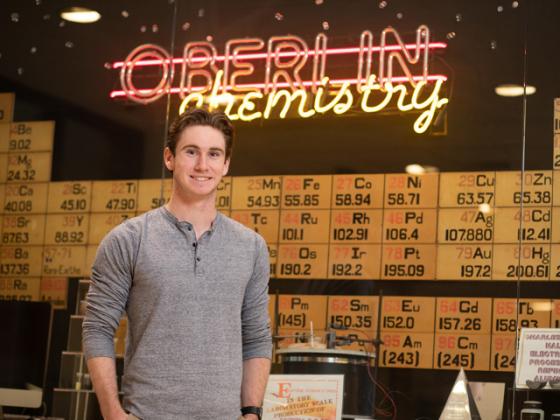
Nexial Prizewinner
Jane Sedlak '19 believes the fundamental principles of chemistry will help solve some of the most urgent societal problems, including climate change and air pollution. She also thinks a lot about the crossroads of chemistry and art—specifically, the chemistry of colors.
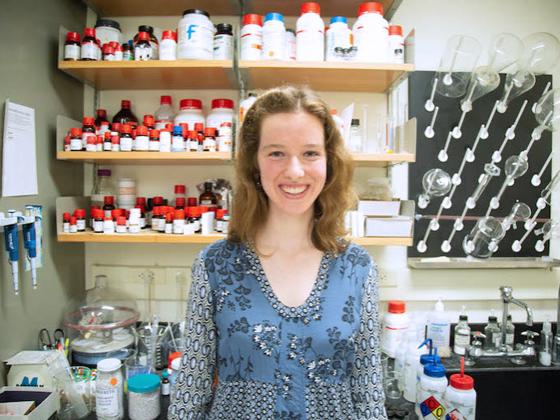
In Search of Renewable Energy
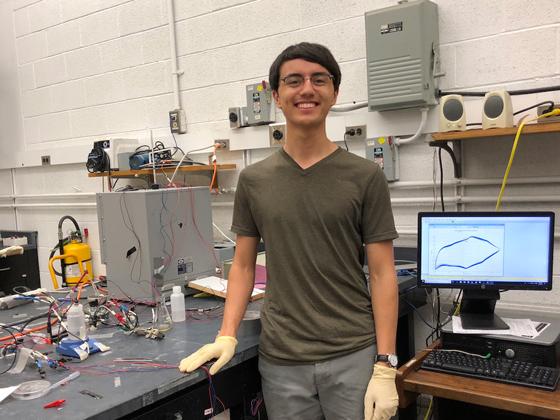
Andrew Santiago '20 manages a rigorous schedule that allows him to take lessons in flute performance while majoring in chemistry and physics. During a summer break he balanced research into aqueous sodium ion batteries with flute practice.
What does Chemistry at Oberlin look like?

Professor Manish Mehta demonstrates an NMR probe for students.

Chemistry major William Dresser '19 worked with Professor Matt Elrod on atmospheric research during winter term.

In Lisa Ryno’s lab, students use fluorescence and scanning electron microscopy to explore antibiotic stress responses.

Students in Professor Jason Belitsky's lab discuss their research on Melanin pigments.
