|
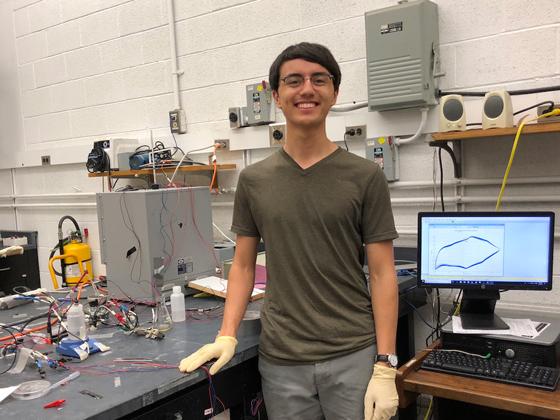
The ovarian cancer biomarker CA125
is a very large (>2 million Dalton), abundantly
glycosylated protein that is found at elevated
levels in the serum of many women with ovarian
cancer. The development of novel detection strategies
for CA125 is a central concern in the Whelan
lab. Surface Plasmon Resonance Spectroscopy (SPR)
provides a means of detecting protein-protein
interactions in real time and without the need
for labels. One important application of SPR
is in the context of assays to detect proteins
that are biomarkers of disease. In this project,
an antibody molecule that recognizes the ovarian
cancer biomarker CA125 will be immobilized onto
the sensing surface of an SPR instrument, creating
a specific test for CA125. Other Interests: motorcycles and vintage cars, playing trombone, EMS (Emergency Medical Services), knitting, reading
~~~~
Researchers and textbook writers who deal with enzyme-catalyzed reactions tend to over-interpret the mechanistic significance of saturation kinetics. By using the reaction that historically defined saturation kinetics, the catalysis of sucrose hydrolysis by the enzyme invertase, and comparing it with the catalysis of raffinose (another sugar) hydrolysis by invertase, I am trying to show that the presence or absence of saturation kinetics can depend upon the available stock solutions of reactants, even when the reaction mechanism is unchanged.
~~~~
Ryan Felix ‘08
In this study we are investigating the mode
of intramolecular [2+2] photocycloaddion reactions
of bis-enones to give either bicyclo[n.1.1] or
bicyclo[n.2.0] ring systems as a function of
the chain length of the intervening methylene
chain that tethers the two reacting ends. We
are interested in this reaction both in terms
of the mechanistic questions posed by this system
(and its relationship to other well-known intramolecular
[2+2] photocycloadditons) and the synthetic possibilities
of producing 5,6-disubstituted bicyclo[2.1.1]hexanes
which are of interest in our lab as an advanced
synthetic intermediates directed towards the
synthesis of bicyclo[2.1.1]hexan-5,6-dione.
Amelia Hadler ’08 Atlanta,
GA
In recent years, there has been increased interest
in synthesis of hybrid inorganic-organic network
compounds, in which single metal atoms or metal
clusters are linked by organic ligands. Some
compounds have been prepared using transition
metal cations, organic ligands, and complex metallate
anions including molybdate (MoO42–) and
tungstate (WO42–). In the resulting structures,
both the organic ligands and the metallate anions
act as bridges between metal centers. ~~~~
Robert Hartley ‘08
As the available computing power continues
to increase, computer models of chemical systems
are becoming more and more important and informative.
I am performing molecular dynamics simulations
(which use pre-calculated atom, bond and angle
properties to simulate molecular motion) and
quantum chemical calculations (which numerically
solve the Schrödinger equation) to study
the effects of solvation on simple di and tripeptides.
We are performing these simulations using desktop
machines and Oberlin’s 70-node supercomputer.
Our computational studies complement experimental
NMR measurements, made locally by other members
of the research group, and provide a more detailed
view of the structure and dynamics of model proteins
in various solvent environments. Our ultimate
goal is to apply what we learn about these small
peptides to larger ones and to the secondary
structure of biologically significant proteins. ~~~~
Serena Hsin ‘09
The nitrate radical (NO3) is the dominant oxidant
in the nighttime atmosphere. Because both ground
level ozone and aerosols are primarily photochemically
produced during daytime hours, nighttime oxidation
chemistry has less received less study. We have
undertaken studies of the kinetics of the nitrate
radical-initiated oxidation of several atmospherically
abundant alkene compounds. We are carrying out
product identification and kinetics experiments
that are performed using the Turbulent Flow Chemical
Ionization Mass Spectrometric (TF-CIMS) kinetics
technique.
Matthew Aaron Leyden ‘08
Recently in cooperation with Dr. Richard Suenram
at the University of Virginia, the first microwave
(MW) spectra of cis-hexatriene were observed
despite the very small (~0.05 D) dipole moment.
To obtain much more of this material, which is
needed for the MW spectra of the three 13C isotopic
variants in natural abundance, various synthetic
methods are being explored. We plan to use the
rotational constants from the MW investigation
to complete the analysis of the rotational structure
in several C-type bands observed with high-resolution
infrared spectroscopy. The ultimate goal is a
semi-experimental equilibrium structure for both
the cis and trans isomers of hexatriene. Such
structures will test the hypothesis that pi-electron
delocalization increases with length of the chain
in conjugated polyenes and that this effect is
reflected in larger changes in bond lengths than
in butadiene. ~~~~
There exists a need for a simple test for the
capsaicins (double-bond in the acyl chain of
the capsaicinoid molecule) and non-capsaicins
(all single bonds in the acyl chain) in chili
pepper fruit. A simple and quick test would provide
chili pepper growers important feedback as they
attempt to breed both hotter and milder chilis.
The goal of this project is to design and develop
a colorimetric procedure to determine 6-ene-8-methyl
capsaicin (and analogs) and 8-methyl dihydrocapsaicin
(and analogs) in chili pepper fruits. ~~~~
Emily Minerath ‘09
Atmospheric aerosols (particles
small enough to remain airborne) have an important
effect on air quality and climate through their
ability to scatter and absorb radiation and to
serve as nuclei for cloud formation. It is now
well known that these aerosols have significant
organic content, despite the fact that most organic
compounds in the atmosphere are expected to be
too volatile to readily form condensed phase
compounds. The conversion of smaller more volatile
organic compounds into larger less volatile compounds
via acid-catalyzed reactions has been proposed
to explain this seeming contradiction. In particular,
carbonyl-containing organic compounds are known
to undergo aldol condensation reactions in acidic
media. Since sulfuric acid aerosols are ubiquitous
in the atmosphere, it has been proposed that
these types of reactions are responsible for
the build up of organic materials on aerosols.
In order to address whether such reactions can
take place on atmospheric aerosols, we have undertaken
kinetics studies of reactions of organic compounds
in sulfuric acid solutions that are representative
of atmospheric sulfuric acid aerosols.
CA125 is an important biomarker,
widely used in the diagnosis and monitoring of
ovarian cancer. Recent structural elucidation
of the protein revealed that it contains a large
number of tandem repeat units, each 156 amino
acids long, and within that repeat domain is
a highly conserved 21-mer bounded on each end
by cysteine residues. All known antibodies with
affinity for CA125 bind to one of two unique
sites within this 21-mer, suggesting that this
relatively simple peptide could serve as a mimic
for the intact protein during the development
of CA125 assays. We have used solid-phase peptide
synthesis to prepare the 21-mer peptide and are
currently optimizing preparative HPLC conditions
for its purification. Upon validation that the
correct sequence has been prepared and purified,
the peptide will be used as the target in an
aptamer selection process, to complement the
ongoing work in selecting an aptamer that recognizes
intact CA125. ~~~~
Isaac Nelson-King ‘08 ~~~~
Deacon Nemchick ’09
Methods are being applied to synthesize
specific deuterium and carbon-13 isotopomers
of 1,4-difluorobutadiene. This chemistry depends
on preparing isotopomers of fluoroethylene and
fluoroiodoethylene, joining these two substances
by a photochemical reaction into a difluoroiodobutene,
and removing hydrogen iodide with base to make
1,4-difluorobutadiene. High-resolution (0.0013
cm-1) infrared spectra will be recorded of isotopomers
of the cis,cis and trans,trans isotopomers by
cooperating scientists at the Pacific Northwest
National Laboratory. From the rotational constants
obtained from analyzing the rotational structure
in the high-resolution spectra and from quantum
chemical calculations of vibration-rotation constants,
an equilibrium structure good to 0.001 Å will
be found. The goal is to assess the structural
consequences of substituting hydrogen atoms with
fluorine atoms in butadiene. ~~~~
Alex Nichols ‘08
By virtue of their size and relatively simple
structure, small peptides (short strings of amino
acids) often assume a wide range of low-energy
conformations in solution. As such, they are
exciting and challenging model system for understanding
subtle elements of solvation and their effects
on backbone torsion angles. Using a combination
of liquid NMR, solid-state NMR, X-Ray and neutron
diffraction, and quantum mechanical calculations,
we seek to understand how the solvation state
and associated chemical properties of glycine-
and alanine-containing dipeptides and tripeptides
change as the molecule transitions from the liquid
state to the solid state. ~~~~
Rachel Randall ‘08
Previous experimental studies on the oxidase-like
catalytic behavior of hemoglobin and related
oxygen-carrying proteins have illustrated the
problem of trying to use spectrophotometric methods
to measure hydrogen peroxide concentrations in
the presence of the biological reducing agents
NADH and NADPH. I am examining several different
spectrophotometric methods for assaying hydrogen
peroxide in order to establish whether they are
partly or completely inhibited by NADH and NADPH,
and if so, whether strategies of prior removal
of NADH or three-dimensional calibration curves
that take into account concentrations of NADH
and NADPH will work to circumvent the inhibition.
The information gained will allow more accurate
determination of the ratio of NADH (or NADPH)
consumed and hydrogen peroxide produced when
hemoglobin (or related proteins) catalyzes the
reaction of NADH (or NADPH) with oxygen.
Aromatic compounds make up roughly one quarter
of the atmosphere’s organic inventory.
It is well known that the oxidation of aromatic
compounds leads to the formation of both ground
level ozone and visibility-impairing aerosols
(smog). However, the specific oxidation mechanisms
are not well known. We have undertaken studies
of mechanism of the oxidation of several atmospherically
abundant aromatic compounds. We are carrying
out product identification and kinetics experiments
that are performed using the Turbulent Flow Chemical
Ionization Mass Spectrometric (TF-CIMS) kinetics
technique. ~~~~
Over the past 20 years, nuclear magnetic resonance
(NMR) spectroscopy has developed into a powerful
technique for determining 3-dimensional protein
structures. Our research over the summer involves
NMR experimentation on modified dipeptides, which
consist of linked pairs of amino acids; as such,
they can be considered “smaller versions” of
biologically occurring proteins, which may contain
thousands of amino acids. ~~~~
We are developing a new reaction that will be
useful for the synthesis and chemical modification
and peptides and proteins. The proposed reaction
is member of a class of reactions known as chemoselective
ligations that allow specific sites on biomolecules
to be modified in aqueous solution without the
use of protecting groups. Such reactions are
contributing to advances in bio-imaging, proteomics,
and drug development. The new reaction, aminooxy
peptide ligation, will extend this chemistry
to the amino acids serine and threonine, and
feature peptide formation and site-specifically
labeling in the same pot. Research this semester
will focus on reaction development with model
systems.
Shalini Saha ‘08
Previous experimental studies
on the oxidase-like catalytic behavior of hemoglobin
and related oxygen-carrying proteins have illustrated
the problem of trying to use spectrophotometric
methods to measure hydrogen peroxide concentrations
in the presence of the biological reducing agents
NADH and NADPH. I am examining several different
spectrophotometric methods for assaying hydrogen
peroxide in order to establish whether they are
partly or completely inhibited by NADH and NADPH,
and if so, whether strategies of prior removal
of NADH or three-dimensional calibration curves
that take into account concentrations of NADH
and NADPH will work to circumvent the inhibition.
The information gained will allow more accurate
determination of the ratio of NADH (or NADPH)
consumed and hydrogen peroxide produced when
hemoglobin (or related proteins) catalyzes the
reaction of NADH (or NADPH) with oxygen. ~~~~
Karin Sono ‘08
Eumelanin is the black to brown
pigment in humans and our primary photoprotective
agent. It is an unusual nano-structured biomaterial,
with many fascinating chemical properties that
both influence its biology and role in skin cancer,
and could also be exploited for non-biological
applications, including environmental remediation.
Natural and synthetic eumelanins are known to
bind a range of metals and organic compounds,
and could be applied to the sequestration and
potential photodegradation of environmental toxins.
Previous research in our lab has demonstrated
that polymeric discs coated with melanin derived
from human hair, as well as synthetic melanin
produced by a variety of routes, can effectively
sequester lead and certain organic dyes from
aqueous solutions. We are further optimizing
and characterizing the lead-binding capability
of these materials, particularly those obtained
via biomimetic enzymatic polymerization, to develop
their potential as lead-binding agents for environmental
remediation. ~~~~
Previous experimental studies on
the oxidase-like catalytic behavior of hemoglobin
and related oxygen-carrying proteins have illustrated
the problem of trying to use spectrophotometric
methods to measure hydrogen peroxide concentrations
in the presence of the biological reducing agents
NADH and NADPH. I am examining several different
spectrophotometric methods for assaying hydrogen
peroxide in order to establish whether they are
partly or completely inhibited by NADH and NADPH,
and if so, whether strategies of prior removal
of NADH or three-dimensional calibration curves
that take into account concentrations of NADH
and NADPH will work to circumvent the inhibition.
The information gained will allow more accurate
determination of the ratio of NADH (or NADPH)
consumed and hydrogen peroxide produced when
hemoglobin (or related proteins) catalyzes the
reaction of NADH (or NADPH) with oxygen.
Synthesis of nanoparticles is
currently a very active area of chemical research,
largely because of the interesting properties
exhibited by these nanometer-scale crystals.
The high surface-to-volume ratio of nanoparticles
makes them useful in catalysis. Hydrodesulfurization
of fuels, particularly diesel, is a process that
is frequently catalyzed by molybdenum sulfide
activated by nickel and/or cobalt. That is, the
active site of the catalyst contains Mo, S, and
Co/Ni atoms. The goal of our research is to synthesize
nanoparticles of MMoS4 (M = Ni, Cu, Co…)
compounds, combining hydrodesulfurization activity
with the high surface area offered by nanosize
particles.
~~~~
In recent years, there has been
increased interest in synthesis of hybrid inorganic-organic
network compounds, in which single metal atoms
or metal clusters are linked by organic ligands.
Of particular interest are structures that lack
centers of symmetry. These low-symmetry materials
have useful applications because they can interact
selectively with chiral guest molecules or behave
as non-linear optic (NLO) or piezoelectric materials.
Use of chiral molecules as linking ligands can
promote formation of non-centrosymmetric solids.
The selective detection of biomolecules
in serum is an important tool for basic research
and clinical applications. Traditionally, such
assays have relied on antibody molecules as the
basis of detection. In this project we will explore
a relatively new class of affinity molecules—aptamers—and
develop analytical assays that exploit their
unique advantages. Aptamers are single-stranded
nucleic acid molecules with recognition ability
comparable to antibodies. The process of aptamer
selection begins with a large random pool of
oligonucleotides. The oligos are allowed to interact
with the target protein of interest, and those
that bind well to the target are separated from
those that do not. Good binders are amplified
by polymerase chain reaction, and the cycle of
selection and amplification continues until the
pool converges on a small number of excellent
binders. This year, we will continue to work
on the selection a DNA aptamer that recognizes
CA 125, a protein that is widely used as an ovarian
cancer biomarker. Capillary electrophoresis is
used to separate and collect the population of
good binders. This approach has been shown by
others to increase the speed and efficiency of
the selection process. ~~~~
Small biological molecules, such
as di- and tripeptides, lend themselves well
to quantitative computational analysis, as well
as experimental investigation. The small tripeptides
we are studying are chains of three alanine and/or
glycine amino acids. I am using a combination
of computational techniques to investigate the
secondary structure of these molecules in their
solvated state. Molecular dynamics simulations
use calculated forces and Newtonian laws of motion
to map the trajectories of systems of atoms over
periods of nanoseconds or picoseconds. Ab initio
and semiempirical calculations numerically solve
the Schrödinger equation, using quantum
mechanical principles to calculate various molecular
properties. Oberlin’s 70-node supercomputer
makes it possible to carry out such highly complex
calculations in a reasonable amount of time.
Computational results complement experimental
data collected by other members of the Mehta
lab, using Nuclear Magnetic Resonance (NMR) Spectroscopy.
Discoveries we make in studying these small peptides
can be applied and expanded to provide insight
into important aspects of larger peptides and
proteins, including the process of protein folding. |


Margaret Compton ‘09
Assiatou
Diallo
Bryan
McLain ‘08
Lee
Moore ‘08
Erika
Rohrs ‘09
Matt
Rumizen ‘09
Valentin
Rusu ‘08
Edwin
Takahashi ‘09
Heng
Feng (Fall) Tian ’10
Christa
Wagner ‘08
Sydney
Williams (Beckman Research Fellow) ‘09
Jaie
Woodard ’11 (Double degree)