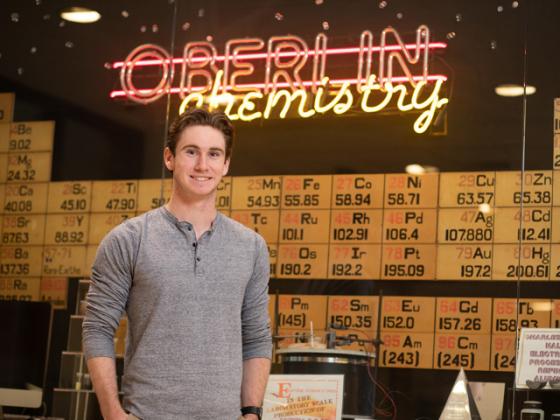
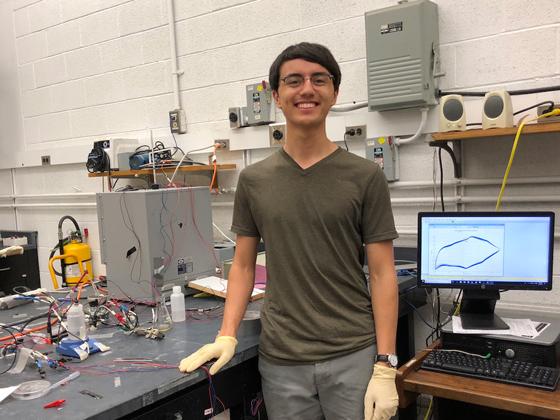
Ben Altheimer '12 From: Greensboro, NC Advisor: Manish Mehta Honors Project: Solid-State NMR Study of Porous Dipeptides Some peptides crystallize into structures with extended 1-dimensional pores which can accommodate a variety of small guest molecules including organic solvents and gases such as methane and carbon dioxide. These materials may be useful in separation or capture of gases. Designing and utilizing these materials and others like them for these purposes requires a better understanding of their behavior. Solid-state nuclear magnetic resonance (SSNMR) can be used to study their behavior. For example, SSNMR can be used to determine whether disordered positions of the pore wall atoms in the crystal structure rapidly interconvert. It can also be used to study how the electronic environments around nuclei change in the presence of a guest. In addition, seven porous dipeptides are known to form an isostructural series in which very similar packing arrangements and conformations are observed. This set of compounds offers an opportunity to study how the SSNMR chemical shift depends on geometrical parameters in a system where an unusual amount of similarity exists between the structures. Other interests: Physics, math, climbing, hiking, the great outdoors. |
||
|
|
||
Adam Birdsall '13 From: Roseville, MN Advisor: Matthew Elrod Research Project: Esterification Equilibria and Kinetics of Methacrolein-Derived Hydroxycarboxylic Acids on Secondary Organic Aerosol Isoprene, 2-methyl-1,3 butadiene, is the most abundant non-methane hydrocarbon present in the atmosphere. This volatile alkene, produced mainly by trees, plays a key role in the formation of secondary organic aerosol (SOA), which is linked to air pollution and climate change mechanisms. One of isoprene’s gas phase oxidation products, methacrolein, apparently undergoes gas phase conversion to a hydroxycarboxylic acid species, which is then observed to undergo esterification reactions on existing SOA. We will synthesize the gas phase precursor and investigate the esterification equilibrium and rate constants for the reactions in model solutions that mimic the composition of SOA using nuclear magnetic resonance analytical methods. These measurements will allow for a more detailed quantitative modeling of isoprene-derived SOA in the atmosphere. Other interests: playing piano, drinking tea, reading anything, watching silent film comedies, dj-ing a WOBC radio show, baking bread, runningWT |
||
|
|
||
Dylan Bleier '15 From: Ithaca, NY Advisor: Matthew Elrod Research Project: Reactions of Monoterpene-Derived Epoxide Intermediates on Secondary Organic Aerosol Monoterpenes are among the most abundant biogenic hydrocarbons present in the atmosphere. These alkenes, produced mainly by trees, are thought to form epoxide intermediates, which play a role in both tropospheric ozone and secondary organic aerosol (SOA) formation, and are thus linked to air pollution and global climate change. We are interested in studying the kinetics of reactions of alpha pinene-derived epoxide intermediates in SOA environments. This work will allow for a more detailed quantitative modeling of monoterpene-derived SOA in the atmosphere. Other interests: Acoustic and electric guitar; The Beatles; squash, racquetball, and ultimate frisbee; backpacking and outdoor survival; The Stephanie Miller Show and This American Life; The New York Times and The Huffington Post; politics/current events, solar energy production, environmental issues, chemistry, physics.
|
||
|
|
||
Simone Brodner '14 From: Portland, OR Advisor: Catherine Oertel Research Project: Ion Exchange Synthesis of Niobium and Tantalum Pyrochlores Complex niobium and tantalum oxides are useful as photocatalysts for processes including water-splitting. Pyrochlores have the general formula A2B2O6, and both the A and B cations influence optical and catalytic properties. Each is made up of a strongly bound [M2O6]2- network associated with loosely bound, exchangeable A+ ions. Using ion-exchange reactions, we are replacing K+ with organic ammonium cations, accessing new hybrid phases that cannot be made using high-temperature or hydrothermal methods. The new compounds are being characterized using powder X-ray diffraction, SEM-EDS, UV-Vis spectroscopy, and thermal analysis. Other interests: Playing lacrosse and baking bread.
|
||
|
|
||
William Burke '14 From: Alpharetta, Georgia Advisor: Robert Thompson Research Project: Forensic Chemistry Finding examples of forensic science applications as reported in newspapers, magazines, and true crime books.
|
||
|
|
||
Adam Darer '12 From: Chestnut Ridge, NY Advisor: Matthew Elrod Honors Project: Gas Phase Oxidation Kinetics and Mechanisms for Atmospherically Relevant Epoxide Intermediates Isoprene, 2-methyl-1,3 butadiene, is the most abundant non-methane hydrocarbon present in the atmosphere. This volatile alkene, produced mainly by trees, undergoes gas phase reactions to form epoxide intermediates. The oxidation of isoprene to epoxide intermediates is related to both tropospheric ozone and secondary organic aerosol (SOA) formation, and thus linked to air pollution and global climate change. We are interested in determining the mechanism and rate constants for the reactions of atmospherically relevant isoprene epoxide intermediates with OH radicals. Specifically, we are investigating the daytime OH radical initiated process using our lab's unique turbulent flow chemical ionization mass spectrometer (TF-CIMS). These measurements will allow a determination of whether gas phase processes dominate the fate of epoxide intermediates, or whether aerosol phase processes. Other interests: Table Tennis, Playing Jazz Saxophone, Dabbling at the piano, Hiking, Canoeing, Beekeeping, and reading.
|
||
|
|
||
Liv Dedon '12 From: Boston, MA Advisor: Catherine Oertel Honors Project: Tuning the Band Gap in Niobium and Tantalum Pyrochlores Complex niobium and tantalum pyrochlore oxides are useful as photocatalysts for processes including water-splitting. Pyrochlores have the general formula A2B2O6, and both the A and B cations influence optical and catalytic properties. Our laboratory has recently prepared tin(II) niobium and tin(II) tantalum pyrochlores using a combination of hydrothermal and ion exchange reactions. The niobium phase has a band gap in the visible range, which is the first requirement for function as a photocatalyst. The goals of this year’s work are to determine the dependence of the band gap on tin(II) content in these compounds, measure photocatalytic performance through an off-campus collaboration, and explore alternative direct syntheses for these pyrochlore phases. Other interests: I like to ride horses and cook.
|
||
|
|
||
Sean Dembrowski '13 From: Altadena, CA Advisor: Catherine Oertel Research Project: Hydrothermal Synthesis of Lead Oxide Carboxylates Lead oxide carboxylates are hybrid inorganic-organic compounds in which Pb2+ ions are coordinated by both oxide anions and carboxylate ligands. Some members of this family occur as corrosion products of lead, while others have the potential to exhibit non-centrosymmetric structures that can give rise to novel optical properties. Very few members of this family of compounds have been characterized structurally. Goals of this year’s work include hydrothermal synthesis and structural characterization of new lead oxide carboxylate phases with ligands including benzoate, tartrate, succinate, and aspartate and application of the partial charge model to understanding factors governing formation of extended inorganic motifs in these compounds Other interests: Running, taiko drumming, juggling, dancing.
|
||
|
|
||
Rae Eaton '13 From: Portland, OR Advisor: Robert Thompson Research Project: Chemistry Research Investigating the Gibbs reaction with capsaicinoids. Developing a solid phase extraction method to isolate the products of the reaction. Other interests: Tea, Fiber Arts, Bread, Sherlock Holmes, Human Diseases.
|
||
|
|
||
Henrik Ehrhardt '13 From: Oswego, NY Advisor: Norman Craig Research Project: Synthesis of Hexatriene-3-d1 for Use in High-Resolution Spectroscopy A reaction pathway is being developed to synthesize hexatriene-3-d1. The proposed method begins with oxidation of 1,5-hexadiene-3-ol to the ketone with Dess-Martin periodinane. This reagent is a hypervalent form of iodine. The product 1,5-hexadiene-3-one will be reduced to the 1,5-hexadiene-3-ol-3-d1 with lithium aluminum deuteride. Dehydration of the deuterated alcohol should give hexatriene-3-d1. The polar cis-hexatriene-3-d1 will be studied with microwave spectroscopy, and the nonpolar trans isomer will be investigated with high-resolution infrared spectroscopy. Rotational constants derived from the spectra will contribute to determining an equilibrium (atoms at rest) structure for the two isomers of hexatriene to assess changes in CC bond lengths caused by pi-electron delocalization. Other interests: Blues dancing |
||
|
|
||
Aaron Garfinkel '14 From: San Francisco, CA Advisor: Robert Thompson Research Project: Forensic Chemistry Finding examples of forensic science applications as reported in newspapers, magazines, and true crime books. Other interests: Lifting things. Climbing things. Looking inside of things. Also, reading, climbing, drawing and dancing (badly) out of the public eye.
|
||
|
|
||
William Gautier '14 From: Norwich, Vermont Advisor: Norman Craig Research Project: Synthesis of Hexatriene-3-d1 for Use in High-Resolution Spectroscopy A reaction pathway is being developed to synthesize hexatriene-3-d1. The proposed method begins with oxidation of 1,5-hexadiene-3-ol to the ketone with Dess-Martin periodinane. This reagent is a hypervalent form of iodine. The product 1,5-hexadiene-3-one will be reduced to the 1,5-hexadiene-3-ol-3-d1 with lithium aluminum deuteride. Dehydration of the deuterated alcohol should give hexatriene-3-d1. The polar cis-hexatriene-3-d1 will be studied with microwave spectroscopy, and the nonpolar trans isomer will be investigated with high-resolution infrared spectroscopy. Rotational constants derived from the spectra will contribute to determining an equilibrium (atoms at rest) structure for the two isomers of hexatriene to assess changes in CC bond lengths caused by pi-electron delocalization. Other interests: I enjoy photography and am currently president of the Oberlin Photo Co-op. I'm also interested in health activism and progress, specifically focusing on underserved populations in urban environments.
|
||
|
|
||
Alex Goertel '14 From: Annandale, VA Advisor: Drew Meyer Project: Extended X-ray Absorption Fine Structure Study on Pb Chelated by Melanin Analogs Melanins are well known biological pigments found in the human skin, hair and brain. One of their important properties involves their ability to attack and bind metal ions and other toxins. The specific nature of binding sites used for different metal ions is not clear, and developing a detailed understanding of the binding geometry will provide for a clearer picture of the pigments capabilities as chelating agents. Melanins extracted or synthesized with different methods can provide unclear conclusions in terms of metal binding. Directly developing a picture of binding site geometry gives us a local probe of the binding site structure independent of melanin preparation technique and will provide a systematic approach to unraveling the structural properties and requirements for metal binding. Using natural and synthetic melanins as a starting point for extended x-ray absorption fine structure (EXAFS) spectroscopy has been used to study systems with different binding capabilities to develop a picture of how structural properties impact binding of environmentally important toxins that melanins are capable of extracting. EXAFS provides us with a local probe of the binding site structure without requiring a detailed knowledge of the overall molecular structure of the pigments. EXAFS data is analyzed using the computational tool IFEFFIT to extract the structural properties of melanin compounds binding lead species. Other interests: Cooking for the coop, baking, living among huge piles of books.
|
||
|
|
||
Joseph Hamilton '12 From: Apollo, PA Advisor: Albert Matlin Honors Project: Hydroxyl-Amine Catalysis of the Nazarov Cyclization and the Friedal-Crafts Acylation Reaction My work has focussed on exploring the ability of hydroxyl amine catalysts to promote the Nazarov Cyclization. Starting Winter Term I will also be looking at the ability of hydroxyl amine to catalyze Friedal-Crafts-like additions of enals to benzofuran and indole. By using a chiral derivative of hydroxyl amine, we also hope to be able perform these reactions enantiospecifically. Other interests: I enjoy hiking, biking, watching movies, and cooking. |
||
|
|
||
Michael Jacobs '15 From: Dayton, OH Advisor: Matthew Elrod Research Project: Synthesis and Reactions of Atmospherically Relevant Epoxide Intermediates Isoprene, 2-methyl-1,3 butadiene, is the most abundant non-methane hydrocarbon present in the atmosphere. This volatile alkene, produced mainly by trees, undergoes gas phase reactions to form epoxide intermediates. The oxidation of isoprene to epoxide intermediates is related to both tropospheric ozone and secondary organic aerosol (SOA) formation, and thus linked to air pollution and global climate change. We are interested in studying the kinetics of reactions of these epoxide intermediates, which require laboratory multistep synthetic preparation, in SOA environments. This work will allow for a more detailed quantitative modeling of isoprene-derived SOA in the atmosphere. Other interests: Watching the Cincinnati Reds play, reading, and watching movies
|
||
|
|
||
Colin Kelly '13 From: Redmond, WA Advisor: Michael Nee Research Project: Synthesis of Adamantamine-capped Polyethylene Glycols Polyethylene glycols (PEG) capped with adamantanamine groups on the ends are being synthesized. The adamantanamine-PEG will be used to isolate cucurbit[7]urils from a mixture of cucurbit[n]urils, where n = 5-10. Other interests: I enjoy playing music, watching south park, and hanging out with friends.
|
||
|
|
||
Holden Lai '15 From: Hong Kong Advisor: Michael Nee Research Project: Preparation of Curcurbituril-Starch Materials Substituted glycourils are being synthesized for the preparation of partially-substituted cucurbiturils. The partially-substituted cucurbiturils are more water soluble than unsubstituted cucurbiturils. The partially-substituted cucurbiturils will be combined with amylose to prepare new cucurbiturl-starch materials. Other interests: Percussion, Running, Talking, Love Poems.
|
||
|
|
||
Elaine Liu '14 From: Newark, DE Advisor: Robert Thompson Research Project: Chemistry Research Investigating the Gibbs reaction with capsaicinoids. Developing a solid phase extraction method to isolate the products of the reaction. Other interests: Dancing, cooking and baking, playing soccer, hanging out with friends, and playing bananagrams.
|
||
|
|
||
Yuhua Lu '12 From: Suzhou, China Advisor: Norman Craig Research Project: Synthesis of Pure cis,cis- and trans,trans-1,4-Difluorobutadiene-1-d1 for Use in High-Resolution Infrared Spectroscopy A new method is being applied for synthesizing samples of the cis,cis and trans,trans isomers of 1,4-difluorobutadiene-1-d1. A previous preparation contained 1/3 of the normal species, which interferes with high-resolution infrared (IR) spectroscopy. The new method depends on exchanging bromoethylene with basic D2O to give its 1-d1 isotopic species, reacting this fluoroethylene with Br2 to make 1,1,2-tribromoethane, reacting this bromethane with AgF2 to make F2DCCBrH, and dehalogenating the fluoroethane to give fluoroethylene-1-d1. Additional chemistry involves the photochemical reaction of fluoroethylene-1-d1 with 1-fluoro-2-iodoethylene to make the isomers of 1,4-difluoro-4-iodobutene-4-d1. The halobutene isomers are dehydroiodinated with base to give the desired products. The analysis of rotational structure observed in high-resolution IR spectra will give rotational constants that will contribute to determining an equilibrium (atoms at rest) structure for the two nonpolar isomers of 1,4-difluorobutadiene. The goal is to determine the influence of fluorine substitution on the CC bond lengths in butadiene. Other interests: Playing chess, go. other board games and playing the piano. Performing magic tricks and wil be teaching a magic trick exco.
|
||
|
|
||
Molly MacInnes '13 From: Albion, MI Advisor: Michael Nee Research Project: Preparation of Curcurbituril-Starch Materials Substituted glycourils are being synthesized for the preparation of partially-substituted cucurbiturils. The partially-substituted cucurbiturils are more water soluble than unsubstituted cucurbiturils. The partially-substituted cucurbiturils will be combined with amylose to prepare new cucurbiturl-starch materials. Other interests: riding horses and playing my flute. |
||
|
|
||
Melanie Melinas '13 From: Ventura CA/Reno, NV Advisor: Manish Mehta Research Project: Solid-State NMR Detection of Protein Folding Intermediates The “folding funnel” theory of protein folding envisions that polypeptides fold on a energy landscape – a three-dimensional map where the horizontal coordinates of a point represent a particular conformation of the polypeptide, and the vertical coordinate represents the free energy of the polypeptide in that conformation – shaped like a rugged funnel, the fully-folded protein at the bottom of the funnel with the lowest energy. The folding protein can thus take many pathways to the bottom of the funnel, and doesn’t have a structurally well-defined single set of intermediates that it passes through. This theory is widely accepted in the protein folding community, yet no funnel has ever been mapped experimentally in more than one dimension. In this project, we aim to learn more about the folding landscape of a small, fast-folding protein known as Trp cage using solid-state NMR methods. In particular, we want to use a “freeze-quench” method whereby a protein solution is heated to denature the protein and is then very rapidly frozen in isopentane before it can refold. This method might capture a transient intermediate or intermediates in the folding landscape of Trp cage. Other interests: Singing, musical theater, playing with cute animals and children, obsessing about Harry Potter, playing Scrabble, skiing, long walks, reading xkcd, spending time with wonderful people, and doing science, of course. |
||
|
|
||
Venkata (Shiva) Mandala '15 From: New Delhi, India Advisor: Manish Mehta Research Project: "Precise measurements of magnetic susceptibilities using a Gouy balance" Modern NMR spectrometers allow for very high resolution spectrum imaging. However, their accuracy is often compromised by the unavailability of adequate and precise data of the magnetic susceptibilities of materials, since the chemical shifts of the peaks due to the diamagnetism of the sample cannot be resolved to as high a degree of precision as the spectrum. My work this Winter Term involves completing a precise Gouy balance to measure the magnetic susceptibilities of different materials with a focus on NMR solvents, that was started previously by a student. I first built a crude balance using a 1 Tesla (at my current setting) electromagnet to study the effect of magnetic susceptibilities, and to roughly calculate the susceptibility of Nickel Chloride using that balance. My work also involves completing the final apparatus for the Gouy balance, which is based around the 14 Tesla superconducting NMR magnet. I am testing the current apparatus for errors caused due to air currents, and finding ways to stabilize the mass readings for the experiment. My work also involves operating a new densimeter, the Anton Paar DMA 5000M, and trying different samples to test its accuracy and repeatability. The density readings are essential for the measurement of magnetic susceptibilities, and thus need to be of a high level of precision too. Other interests: Playing soccer, reading and occasionally coding |
||
|
|
||
Thomas McShane '13 From: Fayetteville, NC Advisor: Peter Chivers Research Project: Metal-protein interactions Metal-sensing DNA-binding proteins control gene expression in response to changes in metal ion levels. Metal-binding selectivity is determined by a set of amino acid residues in a structurally defined metal-binding pocket. Naturally occurring sequence changes can affect the metal selectivity. This project is exploring the effect on metal binding selectivity of an amino acid change in the binding pocket of NikR variant found in a small subset of microbes that also contain a typical NikR. This project involves protein overexpression and purification, followed by metal additions monitored by UV-visible spectroscopy. Other interests: Hiking, playing music, and eating. |
||
|
|
||
Alison O'Connor '12 From: Shaker Heights, OH Advisor: Robert Thompson Honors Project: Honors Chemistry Research Developing an electrothermal atomic absorption method to determine trace cadmium in tobacco. Other interests: Baking vegan goodies, tap dancing, and Joss Whedon shows. |
||
|
|
||
John Paddock '12 From: Harrison Twp, MI Advisor: William Fuchsman Honors Project: NADH Disappearance Does Not Always Mean Oxidation That Forms NAD Since NADH absorbs ultraviolet light around 340 nm wavelength and its oxidation product NAD does not, most investigators who work with NADH assume that when the absorbance of NADH at 340 nm diminishes or disappears, the NADH is being oxidized to NAD. After demonstrating that this is not the case during low pH "oxidation" of NADH, John is examining whether the disappearance of NADH catalyzed by hemoglobin and myoglobin really does produce NAD. Other interests: Taiko Drumming, Reading, languages, Japanese culture, American Indian music, piano, violin, Irish dancing and music. |
||
|
|
||
Thomas Pires '14 From: Carlisle, Pennsylvania Advisor: Peter Chivers Research Project: Metal-protein Interactions Metal-sensing DNA-binding proteins control gene expression in response to changes in metal ion levels. Mutations to protein sequence can increase or decrease metal binding affinity. This project examines the nickel-binding affinity of different mutants of the nickel-responsive NikR repressor that show changes in transcriptional regulation in response to nickel addition. This project involves protein overexpression and purification, followed by nickel titrations monitored by UV-visible spectroscopy. |
||
|
|
||
Laura Rios '12 From: El Passo, TX Advisor: Albert Matlin Research Project: Organocatalysis of the Nazarov Cyclization The Nazarov Cyclization of acyclic cross-conjugated dienones results in the formation of cyclopentenones. Traditionally this reaction has been carried out using strongly acidic conditions including phosphoric acid and aluminum trichloride. Recently the Matlin lab has discovered that the cyclization can be performed under much more mild conditions using hydroxyl amine hydrochloride as a catalyst. My project is examining the scope and limitations of this reaction using both experimental and computational approaches. Other interests: Knitting, reading, obscure Rabelais references, squash, electrons, cooking, nanoparticles." |
||
|
|
||
|
Advisor: Peter Chivers Research Project: Metal-protein Interactions Metal-sensing DNA-binding proteins control gene expression in response to changes in metal ion levels. Mutations to protein sequence can increase or decrease metal binding affinity. Determining these affinities requires titrations of the protein with ligand in the presence of competitor. This project is exploring the use of various competitors to determine their suitably for use in studying metalloregulators of widely differing metal affinities. regulation in response to nickel addition. This project involves protein overexpression and purification, followed by nickel titrations monitored by UV-visible spectroscopy. Other interests: I love dancing in many forms! Particularly ballet and social dancing. I also like tea parties and co-op cooking/eating. |
||
|
|
||
Ari Schwartz '13 From: Columbus, OH Advisor: Robert Thompson Research Project: Forensic Analytical Chemistry Developing an annotated bibliography on analytical methods pertaining to particular types of physical evidence, e.g. blood, glass, paint. Other interests: Watching movies, playing the piano, and cooking. |
||
|
|
||
James Shallcross '14 From: Metuchen, NJ Advisor: Robert Thompson Research Project: Chemistry Research Investigating the Gibbs reaction with capsaicinoids. Developing a solid phase extraction method to isolate the products of the reaction. Other interests: I like cooking in OSCA, fiddling with computers, and theater. |
||
|
|
||
Liam Sharninghausen '11 From: Bellingham, WA Advisor: Michael Nee Research Project: Preparation of TACN-Silica Hybrid Materials 1,4,7-Triazacyclononane (TACN) is being synthesized by a new shorter route. The TACN will be used to prepare new organic-inorganic hybrid materials containing TACN and silica. Other interests: Tennis and other racquet sports, Learning Old English and Old Norse, Chemistry, Classical music. |
||
|
|
||
Eric Stromberg '14 From: Livonia, Michigan Advisor: Drew Meyer Research Project: Extended X-ray Absorption Fine Structure Study on Pb Chelated by Melanin Analogs Melanins are well known biological pigments found in the human skin, hair and brain. One of their important properties involves their ability to attack and bind metal ions and other toxins. The specific nature of binding sites used for different metal ions is not clear, and developing a detailed understanding of the binding geometry will provide for a clearer picture of the pigments capabilities as chelating agents. Melanins extracted or synthesized with different methods can provide unclear conclusions in terms of metal binding. Directly developing a picture of binding site geometry gives us a local probe of the binding site structure independent of melanin preparation technique and will provide a systematic approach to unraveling the structural properties and requirements for metal binding. Using natural and synthetic melanins as a starting point for extended x-ray absorption fine structure (EXAFS) spectroscopy has been used to study systems with different binding capabilities to develop a picture of how structural properties impact binding of environmentally important toxins that melanins are capable of extracting. EXAFS provides us with a local probe of the binding site structure without requiring a detailed knowledge of the overall molecular structure of the pigments. EXAFS data is analyzed using the computational tool IFEFFIT to extract the structural properties of melanin compounds binding lead species. |
||
|
|
||
Megan Walkenhorst '13 From: St. Louis, Missouri Advisor: Michael Nee Research Project: Development of Greener Organic Experiments New greener experiments for the organic chemistry laboratory are being developed, including the synthesis of esters by the SN2 reaction metal acetates with alkyl bromides. Other interests: Watching movies, cooking, reading, and hanging out with friends. |
||
|
|
||
Izumi Yamakawa '14 From: Tokyo, Japan Advisor: Catherine Oertel Research Project: Hydrothermal Synthesis of Lead Oxide Carboxylates Lead oxide carboxylates are hybrid inorganic-organic compounds in which Pb2+ ions are coordinated by both oxide anions and carboxylate ligands. Some members of this family occur as corrosion products of lead, while others have the potential to exhibit non-centrosymmetric structures that can give rise to novel optical properties. Very few members of this family of compounds have been characterized structurally. Within this project, we are employing hydrothermal synthesis to prepare novel phases with ligands including benzoate and fumarate. Products are characterized through powder X-ray diffraction, thermogravimetric analysis, and IR/Raman spectroscopy. Other interests: Reading, napping, sewing. |