

Physics and Astronomy
Study the fundamental questions of the universe.
Fundamental Questions, Versatile Methods
Collaboration is Community
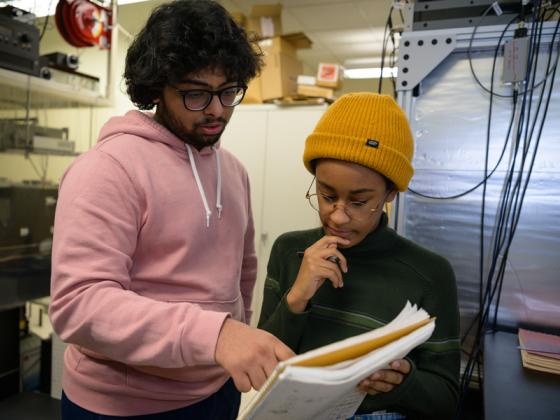
Solve problems with your peers in Wright Laboratory, Oberlin’s home for physics students.
Research Across the World
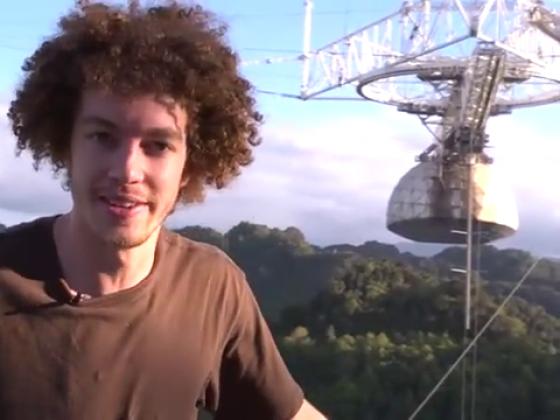
From the Arecibo Observatory in Puerto Rico to the Aperture Spherical Telescope in China.
Undergraduate Research

We have compelling evidence of the existence of dark matter. If detected, dark matter would revolutionize the entire field of physics.
Featured Courses
Einstein and Relativity
How can the speed of light be the same for someone on the sidewalk and someone driving down the road? How can before and after differ for those two people? Don't just calculate the answers to such questions, learn to understand them.
- Taught by
- Dan Styer
Electronics
Explore the analog and digital worlds through circuit design and construction. Transmit sound through light waves, build amplifiers and filters, make a digital thermometer using a microprocessor, and much more. Course starts with the basics and culminates in a final project of your own design.
- Taught by
- Jason Stalnaker
Galaxies and Cosmology
Dive deeply into an understanding of galaxies and their evolution, in the context of an ever-expanding Universe. How do we use color & shape to learn a galaxy’s history? On larger scales, learn how distances are measured to ancient galaxies, and how this taught us about the Universe’s evolution.
- Taught by
- Jillian Scudder
Quantum Mechanics
If insanity is “doing the same thing over and over and expecting a different result” then down at the quantum level the universe is insane. Explore the concepts and mathematics behind the beautiful theory of quantum mechanics which explains this bizarre behavior that governs so much of our modern technology.
- Taught by
- Stephen FitzGerald
Student Profiles
Exploring Interstellar Waves
As part of a summer research project, Jakob Faber ’21 investigated the mysterious properties of interstellar radio waves.
NSF Fellow and Athlete
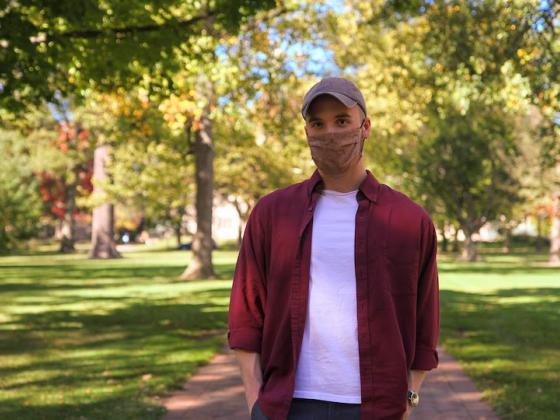
Rainie Heck ’20, received a National Science Foundation (NSF) Graduate Research Fellowship to support doctoral research.
Astrophysics in Montreal
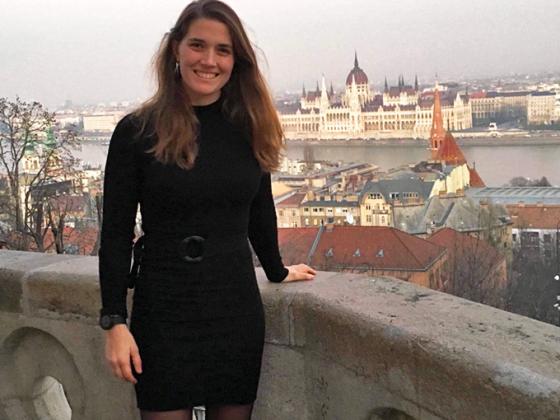
Before beginning graduate work at Cornell, Stella Ocker ’17 conducted summer research at the McGill Space Institute.
Upcoming Physics and Astronomy Events
Observe the night sky
Observe the night sky
Physics and Astronomy Open House
What does Physics at Oberlin look like?

Angel Nunez and Professor Jason Stalnaker aligning their laser frequency comb for a two photon spectroscopy experiment.

Daniel Mukasa designed a copper sample mount for his honors project. Daniel is currently a Ph.D. student in Caltech’s material science department.

Professor Jillian Scudder explaining to her introductory astronomy class what the colors in a beam of light tell us about the universe.

Professor Yumi Ijiri with her research students Ian Hunt-Isaak ‘17 and Jason Heitler-Klevans ‘17 taking a break from contemplating magnetic nanoparticles.
