

Entrepreneurship
Get involved. Get started.
Learn how our programs in entrepreneurship can activate your Oberlin education.
The Oberlin Innovation Studio
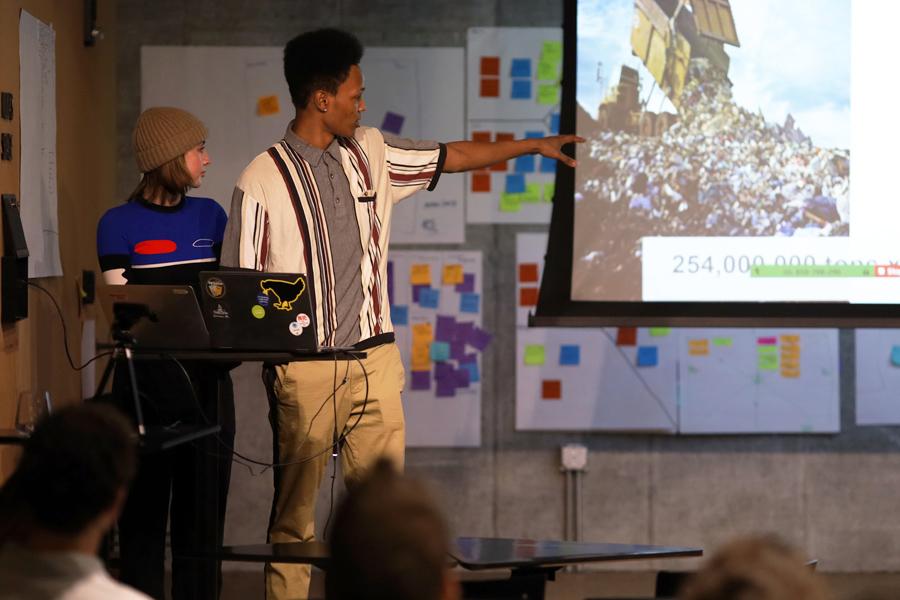
The Innovation Studio fosters entrepreneurial life skills beyond traditional academic settings and works with students enrolled in the Pathfinder program.
Learn, iterate, and succeed as you navigate the intricate world of entrepreneurship. As you evolve with us, a plethora of resources and support awaits to help transition from a compelling pitch to a thriving venture.
Entrepreneurship Across the Curriculum
Business Integrative Concentration
The business integrative concentration, open to students of any major in the college and conservatory, covers foundational areas, including accounting, economics, management, and ethics. Through immersive experiences in organizations from local nonprofits to Columbia Pictures, JP Morgan and the World Bank, students test what they learn in the classroom and apply critical thinking and agile action to a wide range of opportunities.

BUSI 104: Entrepreneurship Fundamentals
Offered yearly, Oberlin’s flagship course in entrepreneurship provides an introduction to core concepts including opportunity evaluation, marketing strategies, the securing of resources, as well as leadership, scalability, and sustainability in a range of contexts. The course also serves as an incubator for students to formulate their own projects they can continue to develop both on- and off-campus.

Arts Administration & Leadership
The Arts Administration & Leadership Integrative Concentration trains students in the business and organizational aspects of arts management and production, from museum administration to rock band management to the film industry. Students will acquire both an intellectual and practical foundation in arts management while also exploring enrichment experiences on stage, in museums, and in other co-curricular activities available in the College and Conservatory.

Social Entrepreneurship
Oberlin’s Social Entrepreneur-in-Residence builds on our long-standing commitment to social change by hosting a recent alum or community member to mentor student fellows on a venture with a direct positive impact in the surrounding community. Under the guidance of Jesse Gerstin, current Entrepreneur-in-Residence, the fellows are researching minority-owned small business growth in Lorain County for ECDI, a community bank.

From the Classroom to the World
The Engaged Liberal Arts at Oberlin takes what you’re learning in your courses and puts it into practice through internships, research, study away experiences, winter term, career exploration, and beyond.

Resource Links
On-Campus Competitions and Grants
Related Programs
Student-Run Co-Ops and Initiatives
Upcoming Events
Executive Speaker Series
Executive Speaker Series
Next Steps
An Oberlin education puts the liberal arts to work in achieving a life of meaning and purpose.
